
How to Run a Fair Promotion Process (Without the Politics)
When promotions feel political, your best people stop trusting the system, and start updating their resumes. Here’s a practical process for making promotion decisions consistent, evidence-based, and fair.
Todd from Tillego
October 8, 2026
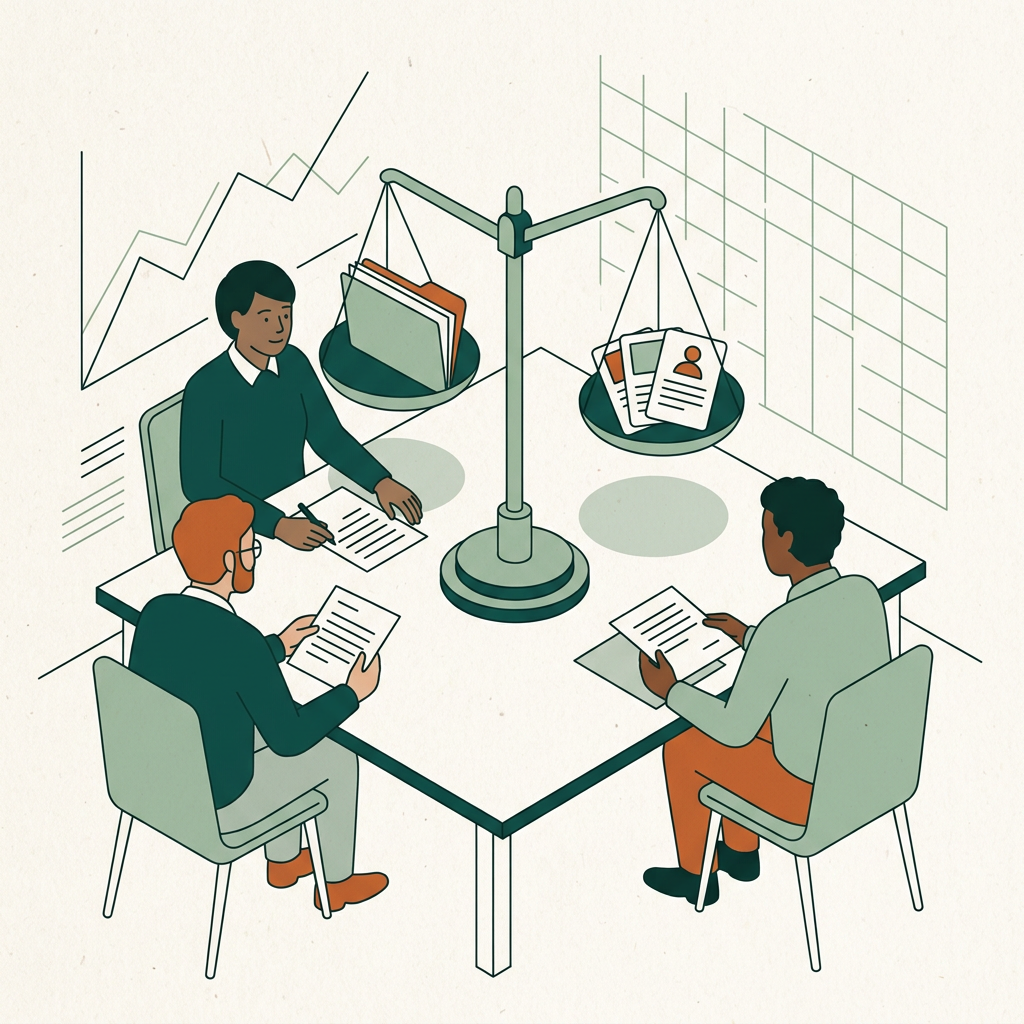
Few things damage a team’s morale faster than a promotion nobody understands. When someone moves up and the rest of the team can’t explain why, people draw their own conclusions: it was about visibility, who you know, or who pushed hardest for a raise.
Most managers don’t set out to be unfair. The problem is that promotion decisions usually happen without a shared standard, a consistent process, or a check on individual bias. Here’s how to fix all three.
Where Promotion Politics Comes From
Unfair promotions almost always trace back to a few predictable gaps:
- No written criteria. Every manager carries their own private definition of "ready for the next level."
- Advocacy over evidence. The people with the loudest manager advocating for them get promoted first.
- Recency bias. One great quarter outweighs a year of steady, high-quality work.
- Self-promotion rewarded. People who are comfortable talking up their own work get ahead of equally strong colleagues who aren’t.
Each of these is a process problem, not a people problem. Which means a better process can solve them.
Step 1: Define the Bar Before You Need It
You can’t evaluate someone fairly against a standard that doesn’t exist yet. Before promotion season, every level should have written expectations. That’s exactly what a career ladder provides: a clear description of the competencies and scope expected at each level.
The rule of thumb: promote people who are already operating consistently at the next level, not people who might grow into it. That keeps the bar the same for everyone.
Step 2: Make Promotions About Evidence
Ask managers to build a short promotion case for each candidate, mapped directly to the next level’s competencies. A good case includes:
- Specific examples of work that demonstrate each competency at the target level
- How long the person has been performing at that level (consistency matters)
- Input from peers and cross-functional partners, not just the manager
- Any competencies that are still developing, stated honestly
Writing it down does two things: it forces the manager to check their instinct against the standard, and it creates a record you can review later for patterns.
Step 3: Calibrate Across Managers
Calibration is the single most effective tool against inconsistency. Bring managers together to review promotion cases side by side against the same criteria. The question in the room shouldn’t be "does this person deserve it?" but "does this evidence meet the bar for this level, the same way it did for everyone else?"
Good calibration sessions have a facilitator, a fixed agenda, and a clear rule that the conversation stays anchored to the written evidence, not to who argues most persuasively.
Step 4: Watch for Patterns
After each cycle, look at the outcomes in aggregate. Are promotion rates noticeably different across teams, managers, or demographic groups? Are some people waiting much longer than others at the same level? Patterns like these don’t prove bias on their own, but they tell you exactly where to look more closely.
Step 5: Close the Loop With Everyone
The people who don’t get promoted deserve as much attention as the people who do. Every candidate who falls short should leave the conversation knowing precisely which competencies need more evidence, and what kind of work would demonstrate them. Fold that into their development plan and revisit it in your one-on-ones.
A "not yet" with a clear path forward builds trust. A "not yet" with no explanation is how you lose people.
A fair promotion process isn’t one where everyone gets promoted. It’s one where everyone understands why.
The Bottom Line
Promotion politics thrives in ambiguity. Write down the bar, require evidence, calibrate across managers, review the patterns, and explain every outcome. Do that consistently and promotions stop being a source of resentment and start being proof that growth at your company is earned.
Frequently asked questions
- How do you make promotions fair?
- Base decisions on a published career ladder, require written evidence against each competency, calibrate across managers before decisions are final, and track promotion outcomes across demographics to catch patterns of bias.
- How often should promotion cycles happen?
- Most growing teams run promotion cycles once or twice a year, tied to performance reviews, so decisions are calibrated together rather than made ad hoc.